
About Applied Taekwon-Do
Applied TaeKwon-do uses alternative applications to the techniques found in the TaeKwon-Do patterns – not the applications which were originally conceived when the patterns were created but supplementary applications that address the common acts of violence that occur on the streets today.
In our standard TaeKwon-Do training we are spending a lot of time developing our sparring skills – and why not? We all enjoy sparring! We also train to progress through our belts; we practice three step and two step sparring and perfect our patterns. Sometimes this can leave a gap in our training; if we were to ever need to defend ourselves, what is the likelihood of being attacked with a turning kick/axekick, backfist, reverse punch, ridge hand combination? Or a hammerfist, reverse turning kick combination? In a self defence situation we are rarely attacked with martial arts. The first combination above is a sparring combination, the second is straight TaeKwon-Do – people just don’t attack you with TaeKwon-Do. The set sparring in TaeKwon-Do does help you develop focus, distance and timing, but it only takes you so far given that you are unlikely to be attacked with syllabus TaeKwon-Do.
Sparring
TaeKwon-Do sparring is really good; many martial arts don’t spar like we do, and are the poorer for it. The student does not have the experience of standing in front of somebody who is really trying to hit them; however, in a self defence environment, sparring teaches some really bad habits. It’s the rules (which are needed for safety, considering how hard we fight) that programme us with these bad habits. We don’t kick below the belt, we don’t grab, sweep, trip or throw. We don’t use our knees and elbows, we don’t attack the groin, eyes or throat. These are the very things that we CAN be attacked with in a self defence situation, and that we need to be familiar with to use in our defence. Given that we are mostly only training two nights a week, there is only so much a student and an instructor can cover. Applied TaeKwon-Do is appreciated best by senior grade students who are looking to supplement their standard TaeKwon-Do.
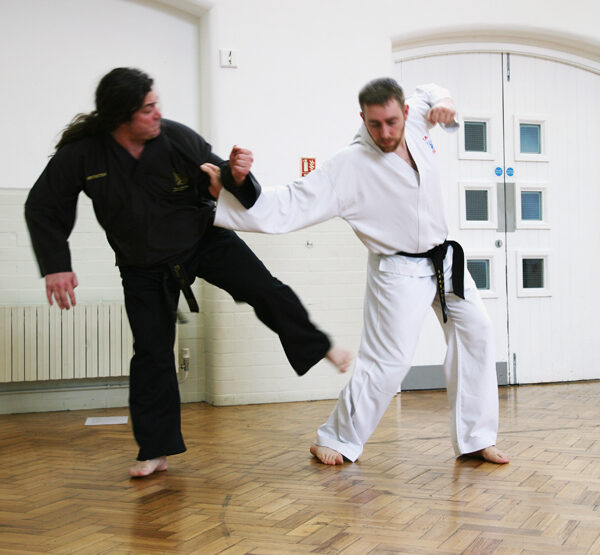
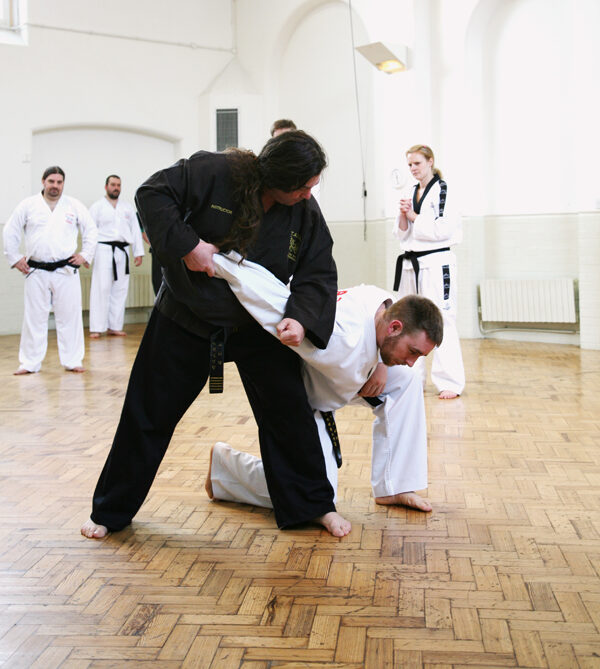
Our TaeKwon-Do can be loosely split two ways; sparring TKD and pattern TKD. Pattern TKD includes traditional technique line work, three step and two step as well as patterns. It’s very difficult for anybody to deny that our pattern TKD is based on Karate. Major General Choi-Hong Hi’s first book in English ‘TaeKwon-Do’ (published 1965) contains thirteen Karate Kata. In the early days of TKD it is clear that they practiced these Karate patterns and only moved completely to the Chang Hon patterns over a period of time. If you look closely at the Karate patterns in the Major General’s book, you find techniques and combinations of techniques are literally ‘cut and pasted’ into TaeKwon-Do, with little or no modification. The stances, punches and blocks are almost identical. Have a look on YouTube – search for ‘Shotokan Heian Kata’ – there are five of them, they are VERY reminiscent of Chon-Ji to Toi Gye.
Whether Major General Choi intended there to be practical applications to the patterns that he created, not many applications have been passed down. The ones that have been are hard to make work in real self defence situations. Maybe the mid twentieth century military needs were different to the needs of modern 21st century urban self defence. The Karate patterns that ours are based on were thought to have contained antedotes to common acts of violence that would occur in civilian situations. These were not battlefield solutions; they were the things that would occur downtown on a Friday night, and this has changed little over hundreds of years. Unarmed people punch you, kick you, grab you, head butt you etc. In some cases they attack you with knives or sticks. It is thought the combinations of techniques found within the older Karate patterns were designed to deal with these common acts of violence.
To be fair to the Major General, in the time he studied Karate (he achieved a second Dan) it had lost much of its real use and application and was being used by the Japanese army as a form of physical and mental training to prepare young Japanese soldiers for war. The fine details and the deep knowledge was not important at this time.

Practical applications
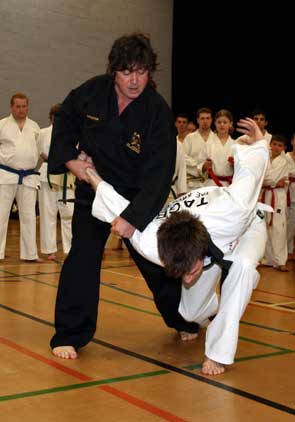
In recent years there has been a new wave of interest in the older and practical applications of all martial arts. Karate pracititioners have been re-discovering and investigating what their patterns were created for hundreds of years ago. It is to these ideas that I have looked to find applications to the techniques and combinations of our patterns. Perhaps the Major General did not intend any practical applicaiton to the patterns, but what is to stop us retro-fitting them ourselves? We practice these patterns day in, day out, we have a muscle memory of the techniques; in some cases the techniques can be used exactly as they are, in others they need a little modification to be used, and some perhaps need treating as a memory aid to ideas and concepts of self defence.